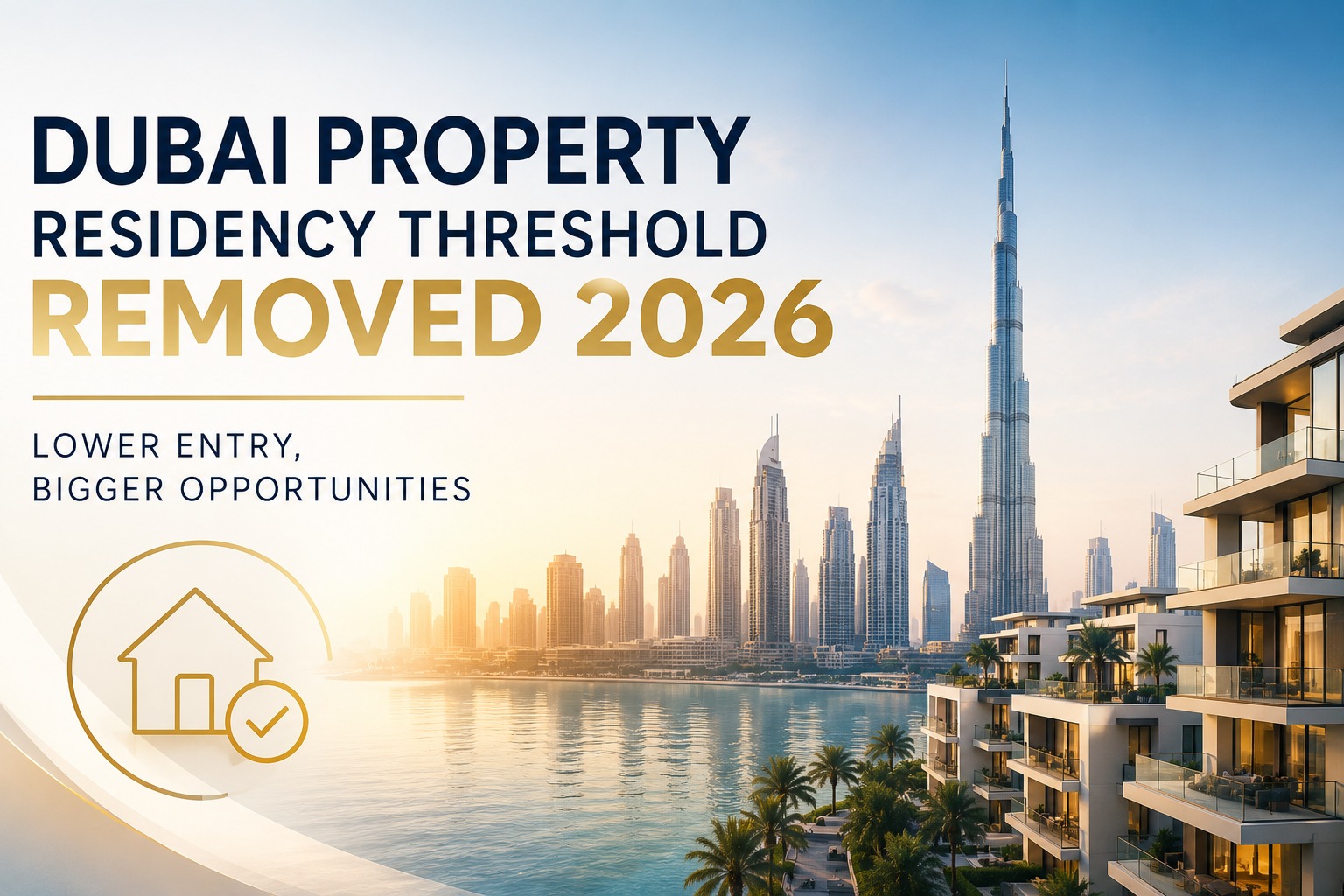
Dubai’s real estate market just became significantly more accessible. The removal of the old AED 750,000 minimum property value requirement for certain investor residency visas is a regulatory shift that will reshape demand patterns across the emirate. The Dubai property residency threshold removed 2026 effectively opens the market to a far larger pool of international buyers, first-time investors, and end-users who were previously locked out purely by visa-related price floors.
In this post, we break down exactly what changed, why it matters for property decisions, which segments stand to gain the most, and whether now is the time to act.
What Changed: Old Rule vs. New Rule
Previously, investors applying for a property-linked residency visa typically needed to demonstrate a minimum property value of AED 750,000. The updated framework decouples residency eligibility from that fixed monetary threshold. Now, individual property owners can apply for residency regardless of the property’s value, provided all ownership and regulatory conditions are met.
| Requirement | Old Rule | New Rule (2026) |
|---|---|---|
| Minimum Property Value | AED 750,000 | None (removed) |
| Visa Eligibility Basis | Property value threshold + standard conditions | Standard conditions only (ownership, title deed, etc.) |
| Buyer Focus | Often forced to select units that crossed the threshold | Freedom to prioritise yield, layout, community, and long-term potential |
| Market Segment Benefiting | Primarily mid-to-high end | Entire spectrum, with a surge expected in affordable and mid-market communities |
In effect, the psychological barrier that forced investors to stretch their budgets just to qualify for residency has been dismantled. Buyers can now enter the market at capital levels that make sense for their investment strategy, not their visa paperwork.
For context on how recent policy shifts are collectively strengthening Dubai’s real estate fundamentals, read our analysis of the UAE withdrawal from OPEC: impact on Dubai real estate 2026.
Why the Rule Change Matters for Investors
The removal of the threshold is not a cosmetic update. It triggers several direct and measurable effects on buyer behaviour and market dynamics.
1. Lower Entry Barrier → More Buyers Entering the Market
Demand was already strong across Dubai’s residential sector. With the AED 750,000 floor gone, a new wave of buyers can now participate—particularly in:
- Affordable apartment communities
- Entry-level investment units
- High-rental-yield projects
- Emerging growth corridors
- Off-plan developments with flexible payment plans
Historically, when access becomes easier, competition accelerates quickly. Early movers tend to secure the best inventory and the most attractive pricing.
2. Investors Can Now Prioritise ROI Instead of Visa Thresholds
Under the old system, many investors selected properties primarily to cross the AED 750,000 mark. That often meant compromising on:
- Unit layout and size
- Rental yield potential
- Community quality and amenities
- Developer reputation
Now, the decision can be purely investment-driven. Buyers can focus on:
- Net rental income
- Capital appreciation forecasts
- Payment plan flexibility
- Developer track record
- Long-term resale demand
This creates a healthier, more rational investment environment.
3. Mid-Market and Affordable Communities Are the Biggest Winners
The new rule directs fresh demand toward communities that offer strong fundamentals without the premium price tags. Key beneficiaries are expected to include projects from:
- Emaar
- DAMAC
- Binghatti
- Sobha
- Aldar
- Nakheel
Communities with high absorption rates, good connectivity, and trusted master-developers could see faster price growth as the buyer pool expands.
Impact Across Market Segments: Who Gains Most?
| Segment | Expected Impact | Rationale |
|---|---|---|
| Affordable Apartments (under AED 750k) | High positive impact | Suddenly eligible for residency-linked demand; buyer pool expands dramatically |
| Mid‑Market Apartments & Townhouses | Moderate to high positive impact | Investors can now choose based on yield, not just price threshold; quality mid-tier assets may see price uptick |
| Off‑Plan Projects | Positive impact | Flexible payment plans combined with lower entry barrier attract first-time international buyers |
| Luxury & Ultra‑Luxury | Low direct impact | This segment was already above the threshold, but overall market confidence could provide a secondary boost |
| Villas & Townhouses (family communities) | Indirect positive impact | Demand remains strong due to lifestyle and limited supply; broader market accessibility may accelerate secondary sales as investors move up the ladder |
In summary, the rule change doesn’t hurt any segment, but it disproportionately benefits affordable and mid-market properties that now sit inside a much larger demand pool.
Best Property Types to Target After the Rule Change
With the residency barrier lowered, different property types offer distinct advantages.
| Property Type | Best For | Why Now |
|---|---|---|
| High‑Yield Apartments | First‑time investors, overseas buyers, rental income strategies | Lower capital requirement; strong rental demand in established communities |
| Off‑Plan Projects | Buyers seeking capital appreciation and flexible payment plans | Developer incentives, modern infrastructure, escrow protections, and phased payments |
| Villas & Townhouses | Families, lifestyle buyers, long‑term capital growth investors | Limited supply, strong migration trends, and enduring lifestyle demand |
| Emerging Community Units | Value investors targeting future growth corridors | Entry prices are lower; infrastructure improvements often unlock faster appreciation |
Crucially, investors can now spread capital across multiple smaller units rather than being forced into a single property that meets an arbitrary price tag. This opens the door to portfolio diversification, even at modest investment levels.
Should You Buy Now or Wait?
Regulatory changes that increase accessibility often follow a predictable pattern. Buyer demand reacts faster than new supply can be delivered. As a result:
- Good inventory disappears more quickly in popular price brackets.
- Developers adjust pricing upward as they detect increased demand.
- Payment plans tighten once absorption rates climb.
- Competition for well‑located units intensifies.
The buyers who move early typically secure better inventory, better pricing, and more negotiating leverage. Waiting rarely rewards those looking for value in Dubai’s strongest communities.
The Dubai property residency threshold removed 2026 is not just a visa tweak—it’s a market‑widening move that will channel fresh capital into segments that were previously off‑limits for residency seekers. Whether you’re a first‑time international buyer or a seasoned investor, this is an opportune moment to re‑evaluate your entry point.
Contact us on WhatsApp for a curated list of high-yield Dubai projects across every budget bracket — from affordable investment apartments to premium villas and off-plan opportunities.
Phone / WhatsApp +971 58 253 1511
Try our free Dubai property tools
Talk to a Dubai property specialist
Licensed brokerage since 1988. Tell us what you are looking for, or get a free valuation based on recorded sales.