On April 28, 2026, the United Arab Emirates announced it would withdraw from both OPEC and the broader OPEC+ alliance, effective May 1, 2026. Unquestionably, this is the most significant defection in the cartel’s 66‑year history, given that the UAE accounts for roughly 11.5% of OPEC’s output. Naturally, such a seismic move has left investors and analysts scrambling to interpret what it means for the country’s most visible asset class: real estate.
In this post, we examine the UAE withdrawal from OPEC: impact on Dubai real estate 2026 in full. You’ll find a balanced analysis of the short‑term headwinds, the long‑term structural tailwinds, and the transmission channels that connect oil policy to property values. Whether you’re a buyer, tenant, or developer, this guide breaks down exactly what has changed – and what to do about it.
1. Why Did the UAE Leave OPEC? A Quick Recap
First of all, it’s essential to understand the motives behind the exit, because they colour how we interpret the real estate implications.
- Production autonomy: The UAE has a capacity of 4.85 million barrels per day (bpd), but OPEC quotas restricted actual output to around 3 million bpd – roughly 30% below potential. Energy Minister Suhail Al Mazrouei stated the exit provides “greater flexibility in using its energy capacity.”
- Monetising reserves before the energy transition: Analysts argue the UAE wants to accelerate extraction while oil still commands high prices, using the proceeds to fund its post‑oil future.
- Strategic rift with Saudi Arabia: The two Gulf powers have fundamentally different goals. Saudi Arabia prefers production cuts to maintain high per‑barrel prices, whereas the UAE favours volume and market share. The UAE did not consult Riyadh before announcing its departure, exposing a deep fracture.
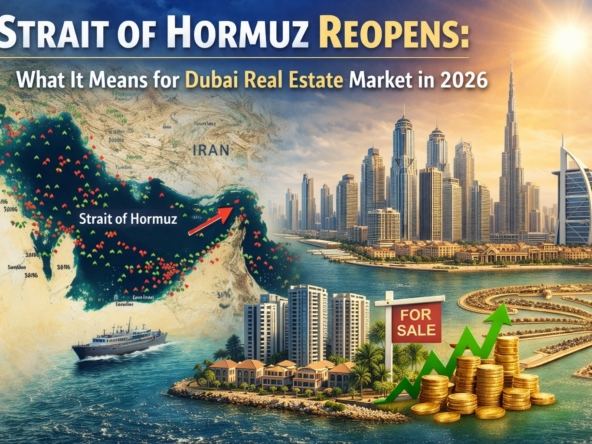
- Unique export advantage: Thanks to the Fujairah port, the UAE can bypass the volatile Strait of Hormuz, granting it a logistical edge that other OPEC members lack.
In short, this was not a petulant move. It was a calculated assertion of economic sovereignty, aligned with a longer‑term diversification strategy that has already reduced oil’s share of GDP to around 20%.
2. The Global Oil Fallout – And How It Hits Real Estate
Before we even get to the property market directly, the exit reshapes global oil dynamics in ways that indirectly influence Dubai property.
- OPEC+’s share of global production drops from roughly 48% to 45%.
- The institutional mechanism that once stabilised prices – a single OPEC+ meeting could move Brent crude 5–8% – has been permanently weakened.
- As a result, traders are pricing in higher long‑term volatility, and some analysts warn of a potential price war if Saudi Arabia retaliates.
However, the relationship between oil prices and Dubai real estate is nuanced. Oil accounts for less than 2% of Dubai’s GDP directly. Instead, the impact flows through an indirect chain:
- Oil revenue ➔ Government spending (infrastructure, megaprojects, free zones)
- Regional wealth ➔ Gulf investment flowing into Dubai property
- Investor confidence ➔ Transaction volumes from international buyers
- Expatriate demand ➔ Housing absorption as the economy grows
Consequently, oil matters for real estate, but not as a simple “price up, market up” equation. In fact, historical data shows Dubai’s market has increasingly decoupled from crude. During the 2014–2016 oil crash (Brent fell from
115tounder30), Dubai property declined 25–30% over five years – fuelled more by oversupply and reduced Gulf liquidity than by oil itself. The COVID‑19 recovery was driven by border reopenings and Golden Visas, not oil.Thus, the OPEC exit matters for real estate not through oil prices alone, but through the broader confidence and capital‑flow effects it triggers.
3. Short‑Term Headwinds for Dubai Property (2026)
Now, let’s examine the immediate risks that have emerged alongside the UAE withdrawal from OPEC: impact on Dubai real estate 2026 is already visible in cautious investor behaviour.
| Risk Factor | Impact on Real Estate |
|---|---|
| Geopolitical Uncertainty | The regional conflict (Iran‑Israel, Strait of Hormuz disruptions) had already cooled high‑end markets; the OPEC exit adds another layer of unpredictability. |
| Skittish Investor Base | Goldman Sachs reported a 37% year‑on‑year drop in UAE real estate investment in early March 2026. Luxury and off‑plan segments are particularly exposed. |
| Oil Price Volatility | Sharp price swings could reduce GCC liquidity, historically a major driver of transaction volumes. |
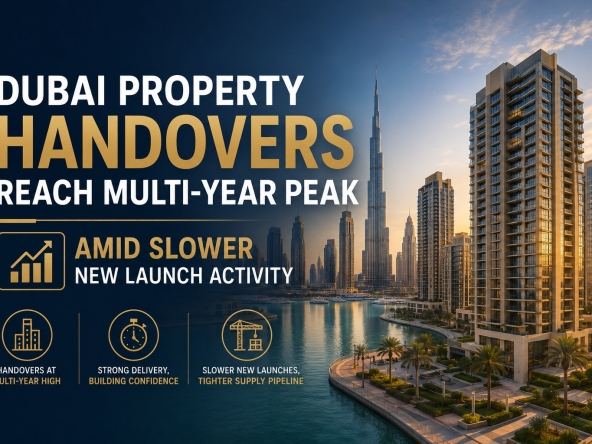
| Oversupply Convergence | Around 80,000 off‑plan units are scheduled for handover in Dubai in 2026. Combined with cautious demand, this could pressure prices. |
| S&P Forecast | Expects “a slowdown in Dubai real estate volumes and a decline in residential prices” amid ongoing instability. |
In other words, the initial reaction is dominated by caution. As the saying goes: “Uncertainty has never flattered luxury real estate.” For this reason, we are likely to see price softening in the most sentiment‑sensitive segments, particularly luxury apartments, short‑term rental hotspots, and heavy off‑plan zones like JVC, Dubai South, and Arjan.
However, it’s crucial to remember that Dubai recorded over 270,000 transactions worth AED 917 billion in 2025 – an all‑time high – and Q1 2026 still showed AED 176.7 billion in sales (+23.4% YoY). So the baseline remains historically robust.
if you are looking for the best deals in the market Contact Us on +971 58 253 1511
4. Long‑Term Tailwinds (2027 and Beyond): Why the OPEC Exit Strengthens Real Estate
While short‑term turbulence is real, the medium‑ to long‑term picture is structurally positive. The UAE withdrawal from OPEC: impact on Dubai real estate 2026 is likely to be remembered as a catalyst that accelerated the market’s maturation. Here is why.
| Long‑Term Opportunity | Real Estate Implication |
|---|---|
| Accelerated Diversification | The exit cements the UAE’s post‑oil trajectory. Real estate, tourism, finance, and logistics become even more central, attracting sustained institutional capital. |
| Higher Government Spending | Freed from quotas, increased oil revenues can fund infrastructure, megaprojects, and new free zones – all of which lift property values in surrounding areas. |
| Dirham’s Fiscal Strength | Output flexibility fortifies state finances, reducing reliance on external borrowing and supporting stable interest rate environments for mortgages. |
| Regional Safe‑Haven Status | As other Gulf states face uncertainty, capital may reallocate toward Dubai and Abu Dhabi, which are perceived as politically and economically stable. |
| Golden Visa Demand | An independent, diversified UAE is a more attractive long‑term home for global talent, feeding rental and sales demand. |
As a result, developers with strong government ties and master‑plan portfolios (Emaar, Aldar, Damac) stand to benefit directly. The government may also accelerate sales of land and free‑zone licences, pumping liquidity into the real estate ecosystem.
In essence, the OPEC exit is a declaration that the UAE will no longer subordinate its economic growth to the collective needs of a cartel. For property, that means a market increasingly driven by fundamentals – population growth, tourism, business formation – rather than oil‑price gambles.
5. What This Means for Different Real Estate Stakeholders
Given these dual forces, how should different market participants interpret the UAE withdrawal from OPEC: impact on Dubai real estate 2026?
For Investors:
- Expect short‑term price softness in sentiment‑driven segments, which may offer buying opportunities, especially from motivated sellers.
- Focus on ready mid‑market properties and established communities that draw on end‑user demand rather than speculative capital.
- Watch GCC-heavy areas where regional buyers might pause; these could see temporary discounts.
For Developers:
- Off‑plan launches may need to be recalibrated with more incentives (discounts, post‑handover payment plans) to attract cautious buyers.
- Government‑backed infrastructure projects will likely increase, presenting partnership and land‑banking opportunities.
- Supply absorption in 2026–2027 will be the key test; developers who can deliver ready units on time will gain market share.
For Tenants:
- Rental growth should moderate further, particularly in luxury apartments and suburban villa communities where new supply is converging.
- In affordable areas like Deira, International City, and Dubai Silicon Oasis, rents are likely to remain stable, as they are driven by fundamental workforce demand.
For End‑Users Buying a Home:
- The long‑term thesis remains intact. An independent UAE with a diversified economy is a safe place to anchor a family, and the OPEC exit reinforces that narrative.
- Mortgage‑dependent buyers should be cautious about short‑term price fluctuations, but historically, timed purchases in Dubai have rewarded patience.
Need personalized advice?
6. Risk Factors: What Could Go Wrong
Naturally, no analysis of the UAE withdrawal from OPEC: impact on Dubai real estate 2026 would be complete without acknowledging the downside scenarios.
- Prolonged Regional Conflict: If the Iran‑Israel tensions persist and the Strait of Hormuz remains disrupted, tourism (12% of UAE GDP) and foreign investment could be suppressed enough to outweigh the benefits of higher oil revenue.
- Oil Price Collapse: If the UAE’s increased production coincides with a Saudi price war or a global recession, Brent could fall sharply, draining Gulf liquidity and triggering a wider regional slowdown.
- Oversupply Absorption Crisis: 80,000 new off‑plan units in 2026 alone could overwhelm short‑term demand if buyer confidence remains subdued, particularly in the mid‑market apartment segment.
- Global Macro Headwinds: Higher interest rates, trade tariffs, or currency volatility could deter the international buyers who now drive a large share of Dubai transactions.
- UBS Bubble Index: Dubai’s elevated position on this index signals potential overvaluation, meaning any shock could be amplified by stretched pricing.
Nevertheless, none of these risks invalidate the long‑term story. They simply underscore the need for selective, research‑driven decision‑making.
7. Conclusion: “Turbulence First, Tailwinds Later”
Ultimately, the UAE withdrawal from OPEC: impact on Dubai real estate 2026 can be summed up in one phrase: turbulence first, tailwinds later.
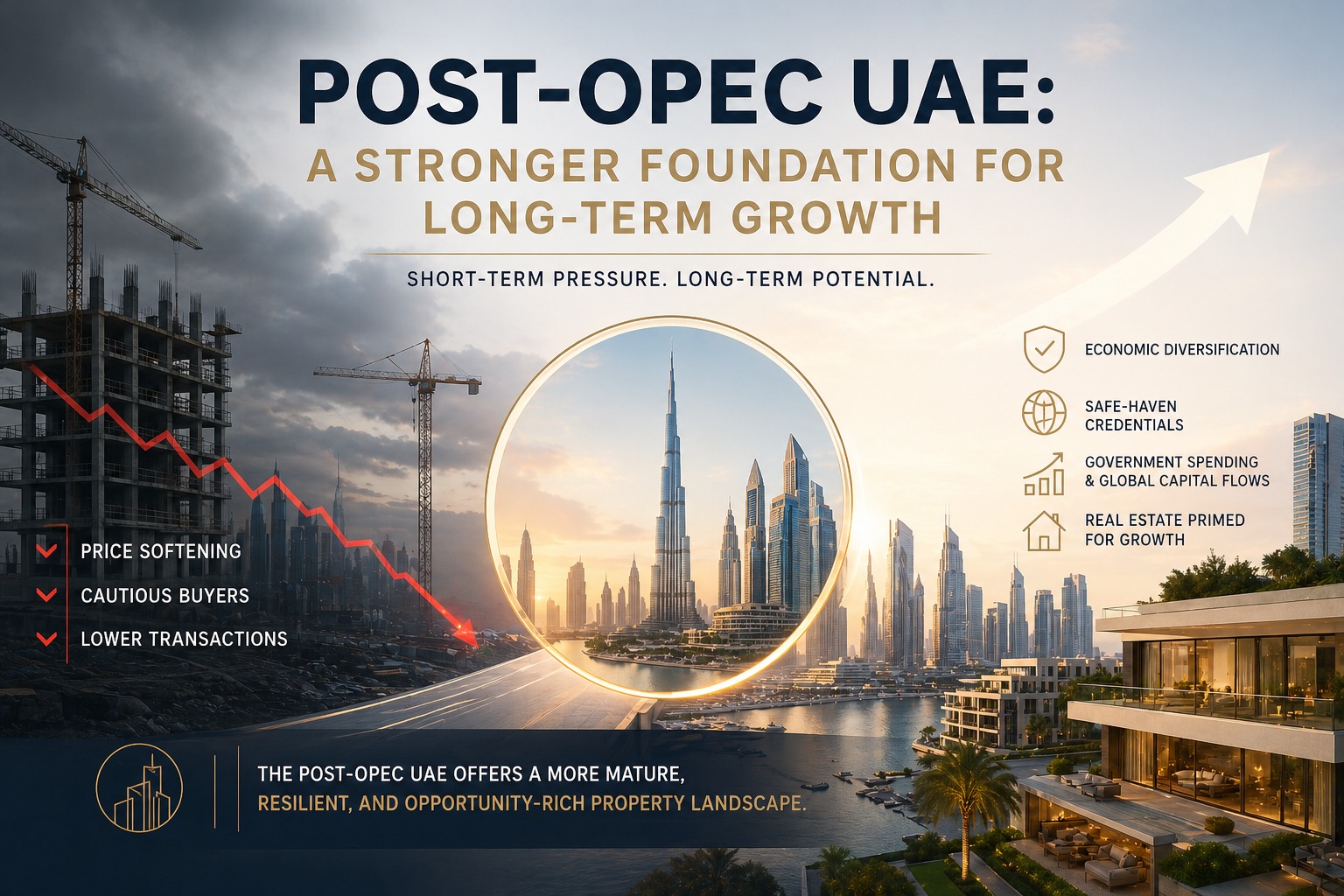
In the immediate term, investors should brace for continued price softening in luxury and off‑plan segments, a cautious regional buyer base, and a slowdown in transaction volumes. On the other hand, the medium‑ to long‑term outlook is remarkable. By freeing itself from collective production constraints, the UAE doubles down on economic diversification, reinforces its safe‑haven credentials, and positions real estate as a primary beneficiary of government spending and global capital flows.
For those who can look through the short‑term noise, the post‑OPEC UAE offers a more mature, resilient, and opportunity‑rich property landscape than ever before.
if you are looking for the best deals in the market Contact Us on +971 58 253 1511