

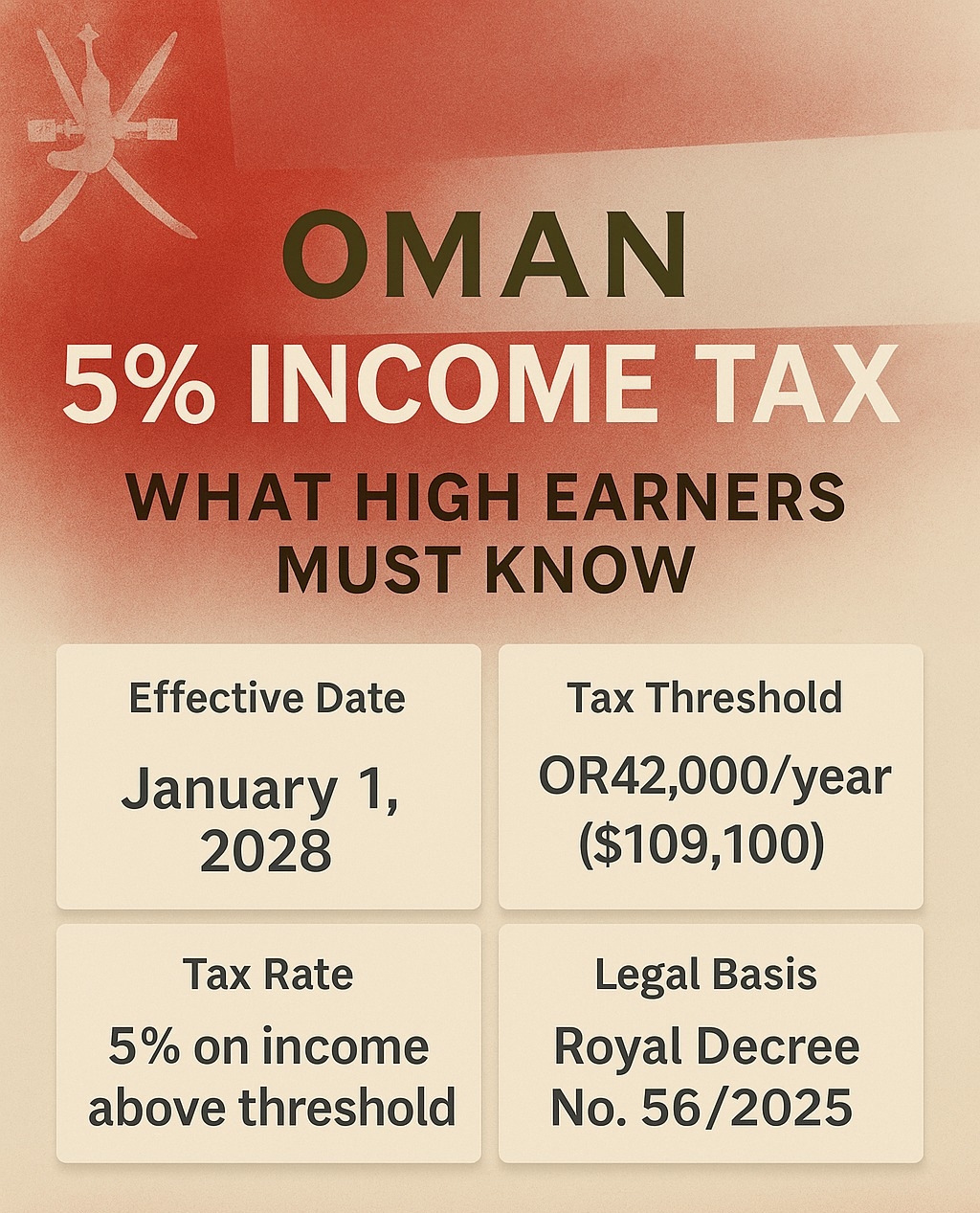
Key Facts at a Glance About Oman’s 5% Income Tax
| Category | Detail |
|---|---|
| Effective Date | January 1, 2028 |
| Tax Threshold | OR42,000/year ($109,100) |
| Tax Rate | 5% on income above threshold |
| Exemption Rate | 99% of Omani citizens unaffected |
| Legal Basis | Royal Decree No. 56/2025 (76 articles) |
Who Pays? The 1% Impact
Oman’s tax targets high-income individuals, exempting 99% of citizens. Key criteria:
- Applies only to annual income exceeding OR42,000 ($109,100)
- Exemptions cover:
- Education expenses
- Healthcare costs
- Housing loans
- Zakat, donations, inheritance
- Digital declaration system for seamless compliance
“This isn’t a burden on society – it’s a strategic investment in Oman’s future.”
– Dr. Said Mohammed Al Saqri, Minister of Economy
Why Oman is Implementing Gulf’s First Income Tax
Economic Diversification Imperative
- Oil/Gas Dependency: 68-85% of state revenue (volatile with prices)
- Vision 2040 Goal: Reduce hydrocarbon reliance → fund essential services:
- Education (39% of budget)
- Healthcare (24%)
- Social Protection (28%)
Global Alignment
- 190+ countries use income taxes to fund public services
- Oman’s 5% rate remains lowest among taxed nations (vs. 20-45% global avg)
Impact Analysis: Citizens vs. Investors
| Group | Impact | Key Advantage |
|---|---|---|
| Omani Citizens | 99% exempt due to high threshold | Social equity via deductions |
| Expats | High-earners pay 5% above OR42K | Still tax-competitive globally |
| Foreign Investors | Zero corporate tax impact | Business rates remain 0%/15% |
| Economy | New revenue stream for OR5B+ social programs | Reduced oil dependency |
Implementation Timeline
- 2025-2027:
- Digital tax portal development
- Executive regulations published
- Jan 2028:
- Tax enforcement begins
- First filings due April 2029
Critical Note: No retroactive application – only 2028+ income taxed
Strategic Actions for High Earners
- Maximize Deductions
- Document education/housing expenses
- Structure charitable donations
- Income Planning
- Consider timing of bonuses/royalties
- Explore tax-efficient investments
- Digital Preparedness
- Register on Oman Tax Authority portal
- Maintain income records digitally
Investor FAQ: Oman’s Income Tax
Q: Will this deter foreign talent?
→ Unlikely. Dubai/Abu Dhabi have 0% income tax, but Oman’s 5% rate remains competitive vs. Europe/US.
Q: How does this compare to VAT?
→ VAT (5% on goods/services) affects all consumers; income tax targets only top 1% earners.
Q: Are investments taxed?
→ No. Applies only to employment/business income above threshold.
Q: Could other GCC countries follow?
→ Saudi/UAE have denied plans, but Oman’s model may inspire fiscal reforms.
Oman’s Vision 2040: Bigger Picture
- Social Protection: 2M+ monthly beneficiaries supported
- Economic Stability: Reduced oil price vulnerability
- Global Integration: Joins 190+ nations with income-based tax systems
Official Resources:
- Royal Decree 56/2025 Full Text
- Oman Tax Authority Portal
- Vision 2040 Roadmap
- Arabianbusiness.com
Key Takeaway: Oman’s 5% tax marks a historic but measured shift toward fiscal sustainability. For 99% of citizens, life continues unchanged – while high earners face modest contributions to fund healthcare, education, and social equity.
Read more:
How the war between Iran and Israel affected the real estate market in Dubai
New Dubai Property Selling Rules for Overseas Investors
Ready to start investing in Dubai?
Contact our investing consultant for free now via WhatsApp or call: +971566333773


