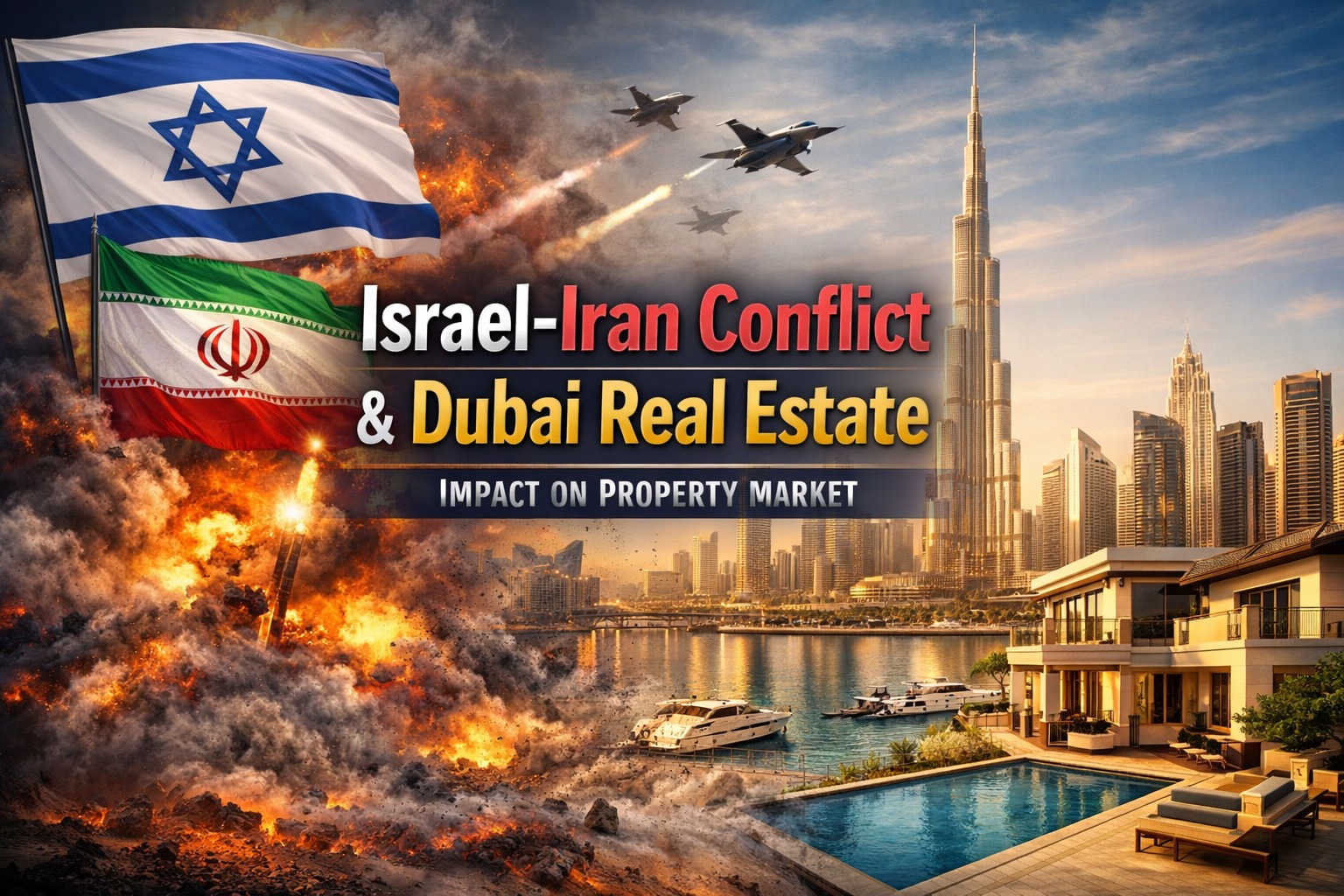
On 28 February 2026, Israel reportedly carried out a pre-emptive strike on Iran, with explosions reported in Tehran and emergency measures activated inside Israel amid expectations of retaliation. This marks a significant escalation in regional tensions, and for Dubai’s property market, the effects will be transmitted through two opposing forces simultaneously:
Fear + uncertainty (short-term shock)
Capital seeking safety (medium-term tailwind)
Dubai’s market enters this period from a position of exceptional strength. The Dubai Land Department reported a record-breaking January 2026, with residential transactions surging 43.9% year-on-year to AED 55.18 billion across 15,756 sales . Off-plan properties dominated at 71.27% of activity . ValuStrat’s index shows approximately 20% annual appreciation as of January 2026, with villas continuing to outperform apartments .
The “war effect” will not move in one simple direction. It will vary by time horizon, market segment, and how far the conflict spreads.
📉 1. The Immediate Impact: Slower Decision-Making, Not an Instant Crash
In the first days and weeks of a major escalation, buyer behavior typically shifts to one default position: pause.
| Segment | Expected Reaction |
|---|---|
| End Users | Delay upgrades (especially large-ticket villas) until headlines calm |
| Investors | Become pickier, request discounts, avoid weak projects |
| Motivated Sellers | Accept sharper negotiation to close deals |
| Market Indicators | Fewer viewings, slower conversions, “wait one month” behaviour |
This pattern has been observed in previous regional shocks. The “real move” in transaction activity usually emerges after clarity returns, not during the initial volatility window.
2. Flights and Tourism: Short-Term Friction, Psychological Unless It Persists
Conflict escalation can disrupt aviation routes and trigger travel warnings, briefly softening tourism sentiment [citation:source]. Current reports indicate broader warnings about flight cancellations and delays in the region.
What this means for Dubai property:
- Holiday rentals / short-stay demand may wobble if travel becomes a sustained headache
- Hospitality-linked investors (hotel apartments, short-let portfolios) could see near-term volatility
However, Dubai’s longer-term demand is driven far more by residency, jobs, and capital inflows than by weekend tourism alone. Historical patterns suggest this is usually a temporary blip—unless airspace risk becomes prolonged.
3. Oil and Inflation: The “Hidden” Lever Affecting Mortgages and Rents
The most significant economic transmission channel is oil.
Markets typically price in a “risk premium” when Middle East conflict escalates, particularly with concerns around supply disruption and shipping routes. Barclays has flagged scenarios where Brent could move higher, with prices already reacting to tensions [citation:source].
Why Dubai buyers should care:
| Impact Chain | Consequence |
|---|---|
| Higher oil → | Pushes inflation expectations up globally |
| Inflation expectations → | Keeps interest rates higher for longer |
| Higher financing cost → | Reduces affordability, especially in mid-market |
If the conflict expands or threatens shipping lanes, expect:
- More cash buyers winning deals
- Mortgage-dependent buyers becoming more price-sensitive
- Developers leaning harder into post-handover plans and incentives
4. “Safe-Haven” Inflows: Dubai Often Benefits If the War Stays Outside the UAE
This is the dynamic many market observers miss: when the region looks unstable, Dubai frequently becomes the “safe Middle East” destination for :
- Regional wealth seeking to park capital
- Families relocating for stability
- Entrepreneurs shifting base to a neutral hub
Historical precedent: Each regional crisis has triggered spikes in Dubai real estate activity :
- 2006–2009: Lebanese investors following internal political unrest
- 2011: Arab Spring surge from Egypt, Tunisia, Syria
- 2019–2022: Lebanese currency collapse, Iranian sanctions, instability in Iraq and Sudan
- 2024: Gaza-Israel conflict drove stronger demand for safe assets in the UAE
Knight Frank has documented Dubai’s ultra-luxury segment remaining extremely resilient, with elevated numbers of $10M+ home deals through 2025. In a contained-conflict scenario, the segments that can actually strengthen are :
- Prime waterfront / villa communities
- Ultra-luxury branded residences
- Grade A office space (if more companies relocate teams)
5. Supply Risk Is Real: War Doesn’t “Cancel” the Pipeline
Even if demand holds strong, Dubai is managing a substantial delivery pipeline. The residential supply forecast for 2026 stands at 131,234 units, with approximately 81% apartments and 19% villas/townhouses . Rating agencies and major outlets have warned that rising supply could create price corrections in some areas, particularly where speculative off-plan demand was concentrated .
A war headline can accelerate this sorting effect:
- Strong projects still transact
- Weaker locations / weaker developers feel the slowdown first
- “Flipper-driven” inventory becomes noisy again
Translation: Dubai does not move as one market. It fragments.
6. What Happens to Rents?
Rents typically react in two opposing directions:
If the conflict drives relocation into Dubai:
- Demand for rentals rises, occupancy stays tight
- Rents supported (especially family communities and prime towers)
If global uncertainty slows hiring / raises costs:
- Tenants downsize, share, or relocate to cheaper areas
- Rent growth cools in mid-market segments
ValuStrat’s 2026 base view includes a more moderate phase—slower capital growth versus 2025, with rents expected to be broadly flat (0%) . A war shock doesn’t automatically reverse this, but it can make tenants more price-sensitive.
3 Scenarios: Simple and Practical
Scenario A: Short Escalation, Quick De-escalation (Most Common Pattern)
| Element | Expected Outcome |
|---|---|
| Market Effect | Brief pause, then normalisation |
| Winners | Ready units, prime communities, cash buyers |
| Your Move | Negotiate hard on motivated sellers; focus on quality |
Scenario B: Prolonged Conflict, But Contained Away from UAE
| Element | Expected Outcome |
|---|---|
| Market Effect | Dubai benefits from safe-haven inflows; luxury holds strong; mid-market becomes selective |
| Winners | Prime assets, branded residences, A-grade offices |
| Your Move | Stick to tier-1 developers, proven communities, realistic payment plans |
Scenario C: Major Regional Disruption (Shipping/Energy Shock, Sustained Aviation Issues)
| Element | Expected Outcome |
|---|---|
| Market Effect | Financing tightens, affordability drops; mid-market pressure increases; prime volatile but can still outperform |
| Winners | Cash buyers, liquidity-focused assets |
| Your Move | Prioritise liquidity (resale demand), avoid “story-only” projects, don’t overleverage |
What I’d Advise (As a Dubai Real Estate Analyst)
1. Emphasise Dubai’s liquidity and transaction momentum
January 2026 delivered record activity—AED 55.18 billion in residential transactions, up 43.9% YoY . The market enters this period from a foundation of depth, not fragility.
2. Segment the message
- End users: Safety and quality-of-life considerations remain intact
- Investors: Strategy should differentiate by asset class and time horizon
- Luxury capital preservation: Prime assets historically benefit from flight-to-quality flows
3. Be transparent about risk
Interest rates and the supply pipeline are the real structural constraints—not headlines alone . The 2026 delivery forecast of ~131,000 units will test absorption capacity regardless of geopolitical noise.
4. Push “quality filters”
In a fragmented market, focus on:
- Tier-1 developer track record
- Handover visibility
- Exit liquidity (resale demand)
- Service charge realism
Final Take
Dubai’s property market has repeatedly demonstrated that regional instability, when contained outside UAE borders, can paradoxically reinforce its position as a capital safe haven . The 28 February escalation will likely produce short-term decision pauses, but the structural drivers—population growth, regulatory clarity, and diversified buyer demand—remain intact .
The key is selectivity. Projects with strong fundamentals, prime locations, and credible developers will continue to transact. Weak projects and speculative inventory will face sharper headwinds. For investors with a 3–5 year horizon and focus on quality, this remains a market where capital can be preserved and grown.
Check Binghatti’s First Ever Villas and Townhouses Community “Tilal Binghatti” Here
Sources: Reuters, Associated Press, Dubai Land Department, ValuStrat Dubai Real Estate Outlook 2026, fäm Properties, Springfield Properties, Knight Frank.
Try our free Dubai property tools
Talk to a Dubai property specialist
Licensed brokerage since 1988. Tell us what you are looking for, or get a free valuation based on recorded sales.